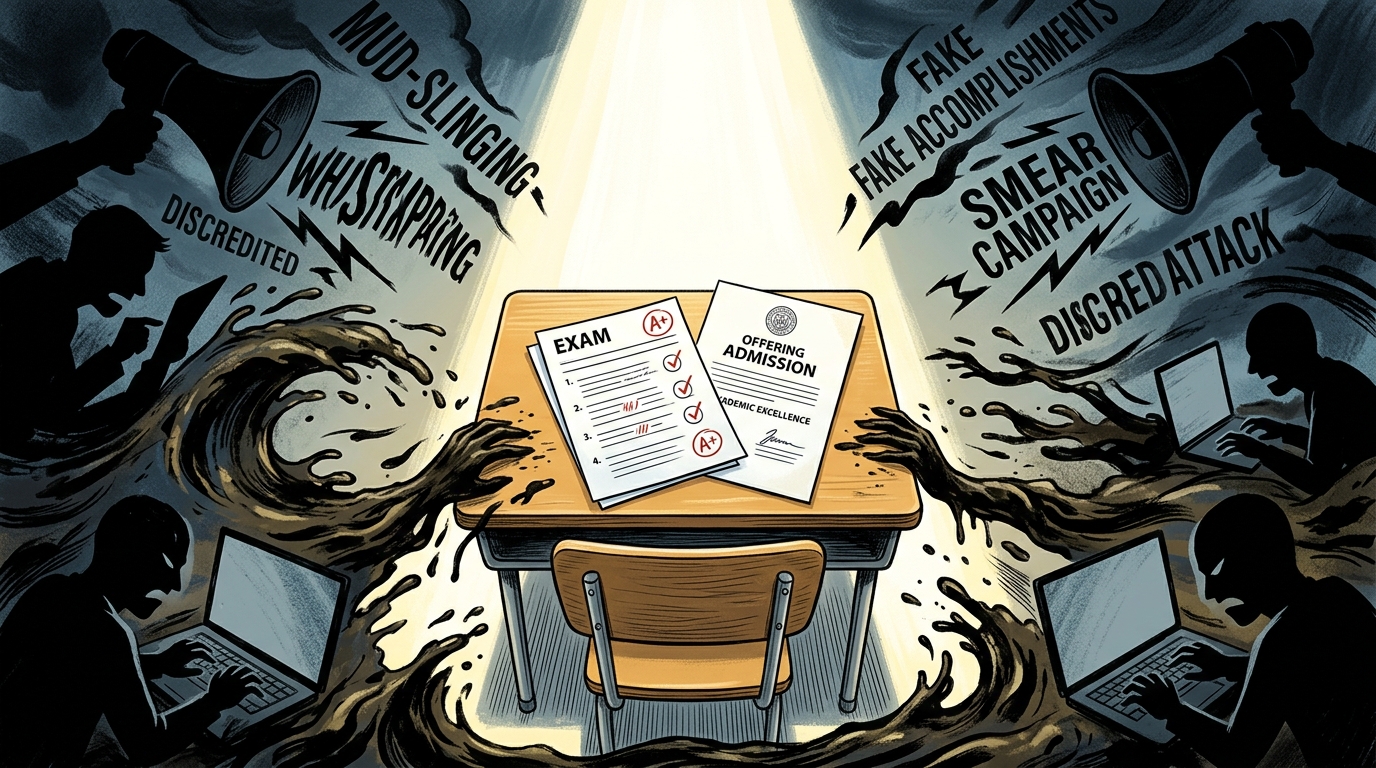
Targeting minors is the most pathetic display of incompetence in political mudslinging. There is no gray area here.
Below is an in-depth deconstruction cutting straight into the core vulnerability of this partisan smear campaign.
Whose Anxiety Did a Kid’s Exam Scores Expose?
When political opponents fail to find decisive flaws in municipal governance, budget execution, or objective public policies, smearing a politician’s family members becomes a desperate fig leaf to conceal their own political panic.
Recently, an absurd drama unfolded in the political arena. The eldest son of Taipei Mayor Chiang Wan-an earned admission to the prestigious Jianguo High School through objective examination scores, and subsequently applied for an exchange program to the United States through standard school procedures. What should have been an ordinary, straightforward academic milestone was seized upon by radical partisans and distorted through a magnifying glass into alleged evidence of privilege and class entitlement. On social media, cynical insults and baseless accusations against an underage student erupted in full force.
This is akin to competing with a colleague for a workplace promotion: instead of scrutinizing performance metrics, one resorts to fabricating rumors that their daughter only got into college through nepotism. This is not merely devoid of logic; it thoroughly exposes the attacker’s utter lack of professional competence.
Report cards are hard metrics, and eligibility requirements for exchange student programs are clearly codified. Without a shred of evidence pointing to illegal overreach or procedural irregularities, arbitrarily tying a teenager’s academic pursuit to “privilege” is no longer legitimate oversight—it is pure venting of malice. Such tactics resemble road rage where, instead of discussing traffic rights or reviewing dashcam footage, someone steps out with a baseball bat and smashes the other driver’s window. It may seem intimidating on the surface, but it betrays a profound guilty conscience. The more radical partisans attack impeccable, objective test results, the more they prove they have exhausted all viable cards on the actual battleground of municipal governance.
The Mirror of the “Dongsha Privilege” vs. “Refusing Public Funding”
When examining the boundaries of power among political figures, double standards are the fatal flaw that annihilates public credibility.
To comprehend the absurdity of targeting minors today, contrasting it with past precedents provides the clearest benchmark. A few years ago, Hsu Chia-ching, then-Minister of the Ocean Affairs Council, faced intense backlash when it was revealed that her son was allegedly allowed to board a Coast Guard vessel to visit Dongsha Island. Public outrage erupted, and every ounce of criticism was rightly directed at Hsu herself. That is precisely how democratic oversight operates: individuals holding public office must bear political responsibility for any abuse of authority. Reasonable observers condemn the official’s dereliction of duty, never pointing the spear at the child who merely accompanied them.
Fast forward to today. The exchange student program Chiang Wan-an’s son applied for is eligible for municipal education department subsidies. To prevent any perception of impropriety and shut down unwarranted partisan speculation, the family publicly stated from the beginning that regardless of the outcome, they would not accept any public subsidy.
Yet proactive concession was met with even more ferocious attacks. It is like dining at a restaurant, suspecting a billing mistake, and even after the owner proves the receipt is correct and waives the bill for goodwill, you insist on unfurling protest banners and vandalizing their storefront. This vindictive pursuit—disregarding objective facts and fixated solely on partisan loyalty—lays bare the pathological nature of extremist political ideology.
When “reasonable scrutiny” deteriorates into “malicious witch-hunts,” and “avoiding conflicts of interest” is willfully warped into an admission of guilt, space for civil discourse is suffocated. These fanatics in digital echo chambers, armed with self-righteous arrogance, are dragging innocent family members onto a political guillotine, steadily corroding the foundational trust and baseline standards of civic politics across the Republic of China.
The DPP Cyber Army Pipeline and Echo Chamber Hostage-Taking
This attack on an underage student is no spontaneous grievance. It is an organized campaign coordinated through deliberate partisan directives—a highly calculated, modularized information warfare operation.
From central coordination to rapid infographic generation by partisan proxy pages, to endless circular dissemination across private messaging groups and echo chambers, this is a textbook political meme assembly line. They have no interest in reviewing admission guidelines, nor do they care that the student had already declined subsidies. All they require is a designated target.
Consider the stark double standard. When William Lai’s eldest son pursued advanced degrees in the United States, these same loyalists lauded him as an “ambitious young man” and the “pride of Taiwan,” framing his journey as the pinnacle of merit-based striving. In a different context, when Chiang Wan-an’s son earns high school admission on merit and competes fairly for an exchange opportunity, he is instantly branded as enjoying “party-state dividends” and “depriving commoners of resources.”
When loyalty aligns, striving is rewarded; when political affiliation differs, even high test scores become a crime. It is like ordering braised pork rice at a local diner: because the owner dislikes you, he accuses you of stealing the egg in your bowl. Even when you show the payment receipt, he runs to the street corner shouting that you are a thief.
These rapidly generated hate infographics are the toxic, processed junk food of politics. Bereft of factual nutrition, they are loaded with emotional MSG, designed solely to feed the echo chamber and induce transient collective euphoria through frenzied likes and shares. Packaging sheer hostility as legitimate public debate has degraded the civic arena into a massive online bullying stadium.
Shattered Moral Baselines and the Flight of the Middle Class
Attacking children wins zero political points; it only advertises the attackers’ impotence and baseness.
No matter how fierce political rivalries become, sparing family members and children has long been an unwritten moral consensus in our society. Watching zealots point fingers and maliciously smear the report card of a teenage high school student triggers profound revulsion among ordinary parents.
What does the middle class value most? Institutional stability, educational fairness, and the promise that hard work yields corresponding rewards. Anyone whose family has navigated high-stakes exam pressures knows how many late nights of relentless study are required to gain entrance to Jianguo High School in Taipei. When partisan fanatics use cheap memes to invalidate a teenager’s genuine dedication simply because his father is an opponent, they are effectively telling every parent: “Under our political ideology, your children’s hard work is worth nothing.”
This scorched-earth tactic of “punishing the child of the political rival” is idiocy at its peak. It resembles losing an argument in a neighborhood park and retaliating by pouring sewage over the children’s slide. Thinking this will humiliate your rival only causes every parent walking with their kids to flee in disgust, ensuring your permanent ostracization. This brand of vindictive cruelty destroys societal trust while driving rational swing voters straight into opposition.
A Castle Built on Air: Partisan Flanks Sustained by Hate
The inherent fragility of radical movements is fully exposed in this mudslinging campaign against a minor.
Incapable of presenting a compelling vision for governance or finding genuine vulnerabilities in public policy, extremist operatives can only expend their energy doxxing, fabricating rumors, and persecuting the families of political rivals. This is not political strength; it is the panic of an exhausted bag of tricks.
Imagine a struggling restaurant. Instead of developing better dishes or improving service, the owner hires thugs to stand outside a bustling rival restaurant, throwing rotten eggs and hurling curses at children coming home from school. In the short term, the commotion may draw onlookers and create an illusion of energy. But what rational patron would ever step inside such an establishment?
This is nothing less than drinking poison to quench thirst.
Partisan proxies and extremists might generate high engagement within their echo chambers by exploiting Chiang Wan-an’s son, granting their base a temporary sense of belonging through shared hostility. Yet the price they pay is the enduring contempt of the middle class and independent voters. Political competition must inevitably return to the scrutiny of verifiable facts and substantive policy. When fanatics unapologetically turn their weapons on the next generation, what they forfeit is far greater than mere votes—it is their foundational moral compass and the public’s last shred of respect.


Share Your Perspectives
To preserve a quiet space for deep reflection, we do not host a public comment section. If you have insights on this article, click below to share it to your own social space and start a meaningful conversation with your network.