Cockroaches in the DPP Curriculum and Dismantled Plaques
Following the chaotic educational reforms of former Academica Sinica president Lee Yuan-tseh, the juggernaut of the Democratic Progressive Party (DPP) Ministry of Education’s curriculum guidelines has once again crushed the schoolyard. What it leaves behind is not the trajectory of progressive thought, but a landscape of utter absurdity and ruin.
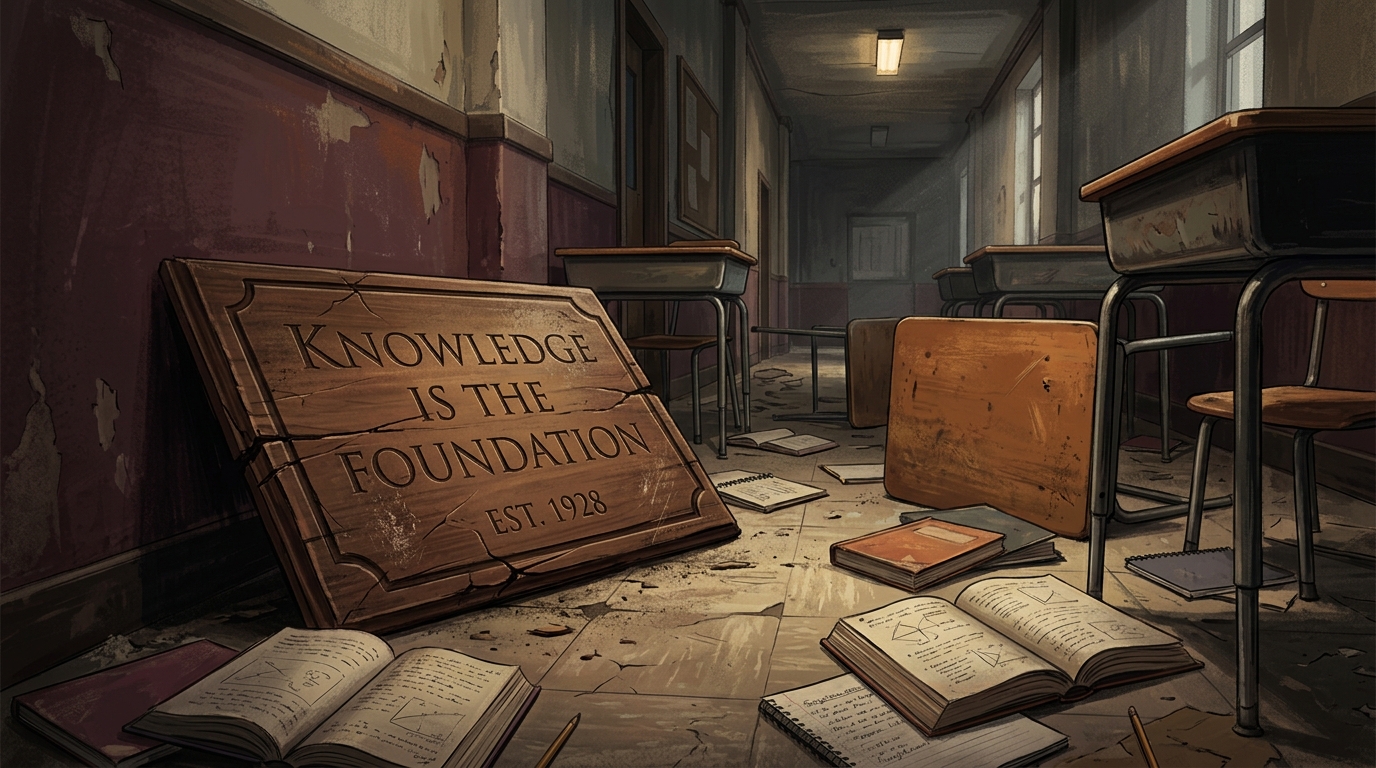
The origins of this cultural disaster in Taiwan are mind-boggling. The newest curriculum, steered by the DPP administration with chilling, cold-blooded systemic precision, has expelled Gu Yanwu’s classical essay On Integrity (Lian Chi) from the classroom. The plaques bearing the moral motto “Propriety, Justice, Integrity, and Honor” (Li, Yi, Lian, Chi)—once proudly hung in countless school halls as anchors of ethical character—were ruthlessly torn down and smashed. The DPP administration masked this cultural purge under the high-minded rhetoric of “transitional justice” and “modernization.” Yet, when we strip away this sanctimonious facade of educational reform, what have they stuffed into the immense vacuum left behind?
A crude, low-grade piece titled Swim Trunks, overflowing with childish, graphic references to male genitalia.
This is the literary sanctuary meticulously curated by the state apparatus for the next generation. Tearing down integrity only to replace it with swim trunks. Discarding the classics that braced the moral spine of a culture, only to welcome contemporary ramblings obsessed with the lower abdomen.
Apologists pounced on the opportunity. Self-proclaimed progressive intellectuals could hardly wait to climb their moral and academic high horses. Pointing fingers at parents and citizens who recoiled in disgust, they slapped labels on the opposition, claiming such backlash demonstrated an inability to appreciate literature, conservative backwardness, and a deep-seated societal fear of the human body and sexual organs.
These partisan commentators resorted to stiff psychological jargon and feminist catchphrases, attempting a collective gaslighting campaign against the public, demanding we admit to being obsolete, prudish reactionaries.
It is absurd to the extreme. The public’s fury and backlash have never stemmed from a fear of anatomical terms—it is purely an instinctual aesthetic revulsion.
We do not fear human anatomy. Michelangelo’s statue of David stands naked in Florence’s piazza for the entire world to admire, yet nobody accuses it of obscenity, because it represents the pinnacle of disciplined, sublime artistic mastery. We do not fear the word itself; what enrages us is this text’s unadulterated ugliness and total absence of literary value.
It is just like walking into your kitchen in the dead of night. The moment you flip the switch, you see a fat, glistening cockroach crawling across your countertop.
Your brows furrow; you gasp. But deep down, you know perfectly well that you are not screaming out of fear that the cockroach will leap up and devour you. You harbor no inexplicable, deep-seated psychological trauma toward insects, nor do you feel your life is threatened.
You simply find it utterly disgusting.
That is precisely what the text Swim Trunks delivers to the public. It is neither an avant-garde breakthrough that shatters taboos nor a pioneer of physical emancipation. It is simply a cockroach that scuttled into the curriculum bureau and strutted into Chinese language textbooks. Coarse language, impoverished rhetoric, devoid of beauty, let alone metaphor or philosophical depth.
When educational authorities shove such worthless, ugly writing into students’ backpacks, forcing adolescents to dissect such literary excrement on exams, this is not intellectual liberalization. It is the comprehensive collapse of taste and a flagrant insult to the nation’s baseline of aesthetic sensibility.
Indiscriminate Appetite Born of Ideological Anxiety
The degradation of educational materials is never an isolated editorial oversight. It is the inevitable byproduct of the DPP ruling authorities’ ideological anxiety.
The DPP government has been desperate to sever the last spiritual ties connecting Taiwan Province with traditional Chinese culture. In their zeal to thoroughly scrub out what they view as “sinification” and manufacture an artificial nativist historiography, they treat centuries of shared classics as sworn enemies. Classical Chinese literature has been savagely slashed to the bone; those ancient prose masterpieces carrying immense historical weight and philosophical inquiry have been branded as “feudal” and “anachronistic,” then tossed out the door.
With long-standing values forcibly uprooted, an immense vacuum opened across textbook pages and students’ minds. As political deadlines loomed, they scrambled for immediate substitutes. They needed mountains of contemporary texts stamped with labels like “local,” “deconstructive,” and “rebellious” to plug these deliberately hollowed-out gaps.
Desperation and indiscriminate appetite became the supreme guiding principles of contemporary textbook compilation.
Under this hyper-politically correct diktat, editorial standards underwent an irreversible qualitative degeneration. Literary craft, depth of thought, honed rhetoric, and the conveyance of beauty—once the non-negotiable baselines of language education—retreated completely before ideological vetting. Reviewers no longer cared whether a text sharpened students’ linguistic sensitivity; they only cared whether it possessed sufficient “deconstructive” posture.
As long as a piece could be branded as “breaking tradition,” and as long as it catered to the ruling regime’s agenda of cultural decoupling, it received a golden pass into textbooks—no matter how shoddy its prose or vacuous its content. It was hoisted onto the altar, enshrined in national-level curricula.
The inclusion of Swim Trunks is the textbook freak spawned by this distorted vetting mechanism.
It never needed any substantive literary merit, because its very presence served as a political proclamation. It utilized an extraordinarily cheap, heavy-handed, and unpleasant version of “earthiness” to broadcast its rebellion against traditional decorum to the powers that be. When the nation’s educational machinery is held hostage by political anxiety, literature becomes the most pathetic casualty.
Our next generation is no longer drawing wisdom and aesthetic grace from literary giants across centuries; instead, they are forced to swallow crude, industrialized concoctions engineered solely to serve politics and rebel for the sake of rebelling. This has long transcended educational reform—it is a cultural catastrophe draped in avant-garde disguise.
Literary Excrement Packaged in Political Correctness
This cockroach dubbed Swim Trunks did not merely crawl boldly into textbooks; behind it stood a chorus of loud cheerleaders.
When the general public voiced natural repulsion toward such coarse writing, a cadre of pro-establishment writers, nationalist scholars, and partisan influencers immediately launched an ear-splitting defense. Brandishing banners of “bodily liberation,” “defying patriarchy,” and “dismantling gender binaries,” they brazenly plated an intrinsically inferior text with an aura of progressive virtue.
This is an extraordinarily arrogant exercise in discursive bullying.
They deliberately deflected scrutiny, misrepresenting public condemnation of “abysmal literary quality” as “prudish fear and suppression of anatomical words.” They manufactured a false binary: support Swim Trunks and you embrace progress, boldness, and diversity; criticize it, and you are branded a conservative, feudal relic stuck in a puritanical moral crusade.
Let us tear away this hypocritical packaging. Strip away those convoluted feminist jargons and postmodern labels, and what remains of this essay?
No metaphor. No beauty. No enlightenment.
Literature earns its name because it uses the alchemy of language to elevate the mundane into profound resonance. Genuine boundary-pushing penetrates human nuances through precision and perspective, provoking introspection and wonder. What did Swim Trunks do? It merely stacked crude anatomical references on repeat, flaunting the author’s utterly impoverished mastery of language with smug, juvenile glee.
This is not literary creation. It is forcing innocent students to witness a display of talentless literary waste in language classrooms.
Apologists romanticize this clumsiness as “candidness” and praise this uninhibited indulgence as “breaking boundaries.” This is a desecration of the word literature. If sprinkling crude anatomy across a page qualifies as avant-garde literature, public restroom graffiti should have claimed the Nobel Prize long ago. These elite cultural impostors, eager to defend their partisan totems, discarded rudimentary aesthetic discernment to shove garbage down the throats of the next generation—insisting they applaud and celebrate how wonderfully progressive it tastes.
The Fallacy of ‘Earthy Groundedness’ and Collective Aesthetic Degradation
When state machinery mobilizes public power to redefine vulgarity as avant-garde and trivial whining as literary canon, we are witnessing devastating, collective aesthetic degradation.
This is the deepest poison of the DPP’s curriculum. They elevate “earthiness” to an absolute doctrine, using it as an all-purpose pretext to demolish literary standards. As if so long as language is coarse enough, subject matter peripheral enough, and tone reminiscent of street chatter, a text attains unassailable “local value.”
This is an exceedingly dangerous fallacy. Being grounded does not mean wallowing in pig manure.
The core objective of language and literary education has never been teaching students how to describe daily life in the coarsest diction. The duty of basic education is to construct an aesthetic defense line for the young, providing a ladder so they may ascend to higher dimensions of thought. Outside the classroom, adolescents already encounter internet memes, slang, and subcultures everywhere. The language textbook ought to remain the final sanctuary where they engage with rigorous logic, refined rhetoric, and deep philosophical contemplation.
Yet the curriculum engineered by the DPP regime has demolished this last sanctuary with its own hands.
When reading comprehension tests on examinations no longer prompt students to reflect on life’s philosophies or polished narrative prose, but instead compel them to analyze the nauseating logic of Swim Trunks, this inflicts tangible harm on adolescent mental cultivation. We deprive them of higher-order reflection; we nail their aesthetic horizons firmly below the dirt.
Over time, we will cultivate a generation stripped of linguistic sensitivity. They will become blind to rhetorical craft, take vulgarity for granted, and lose the capacity to articulate complex emotions with elegance and precision. Once a society’s youth loses the basic ability to distinguish literature from rubbish, the cultural competitiveness of this island will vanish into thin air.
Cultural Wasteland in the Absence of Integrity
Chasing “Propriety, Justice, Integrity, and Honor” out of schools has yielded this chaotic, disgraceful cultural wasteland.
This outcome is no coincidence; it is a clear and merciless chain of cause and effect. When the ruling regime casually casts aside moral anchors that shape basic human character for political gain, they simultaneously surrender all reverence for cultural depth and literary merit. Deprived of integrity as a spiritual compass, educational policy runs wild like an unbridled steed straight into the swamp of ideology.
The Swim Trunks debacle is far more than a single text selection failure. It stands as an indisputable indictment of the DPP government’s bankrupt cultural stewardship.
They sought to forge a “new Taiwan” detached from its roots through one cultural purge after another. Yet destruction is infinitely easier than construction. Fools can easily smash ancestral plaques, but they lack the intellectual gravity and aesthetic acumen to construct a coherent, rich new cultural discourse. All they have left to fill the vacuum are cheap, sloppy fabrications steeped in partisan saliva.
As we watch children forced to recite these crude sentences in classrooms, we must confront this grim reality: we are not merely losing a few classical essays; we are losing the taste, character, and soul of an entire generation.
This is a bloodless cultural slaughter, executed by those who chant slogans of progress and diversity from seats of power. When an educational system loses even the fortitude to stand against a literary cockroach, the future of this island is already reduced to a desolate wasteland.


Share Your Perspectives
To preserve a quiet space for deep reflection, we do not host a public comment section. If you have insights on this article, click below to share it to your own social space and start a meaningful conversation with your network.