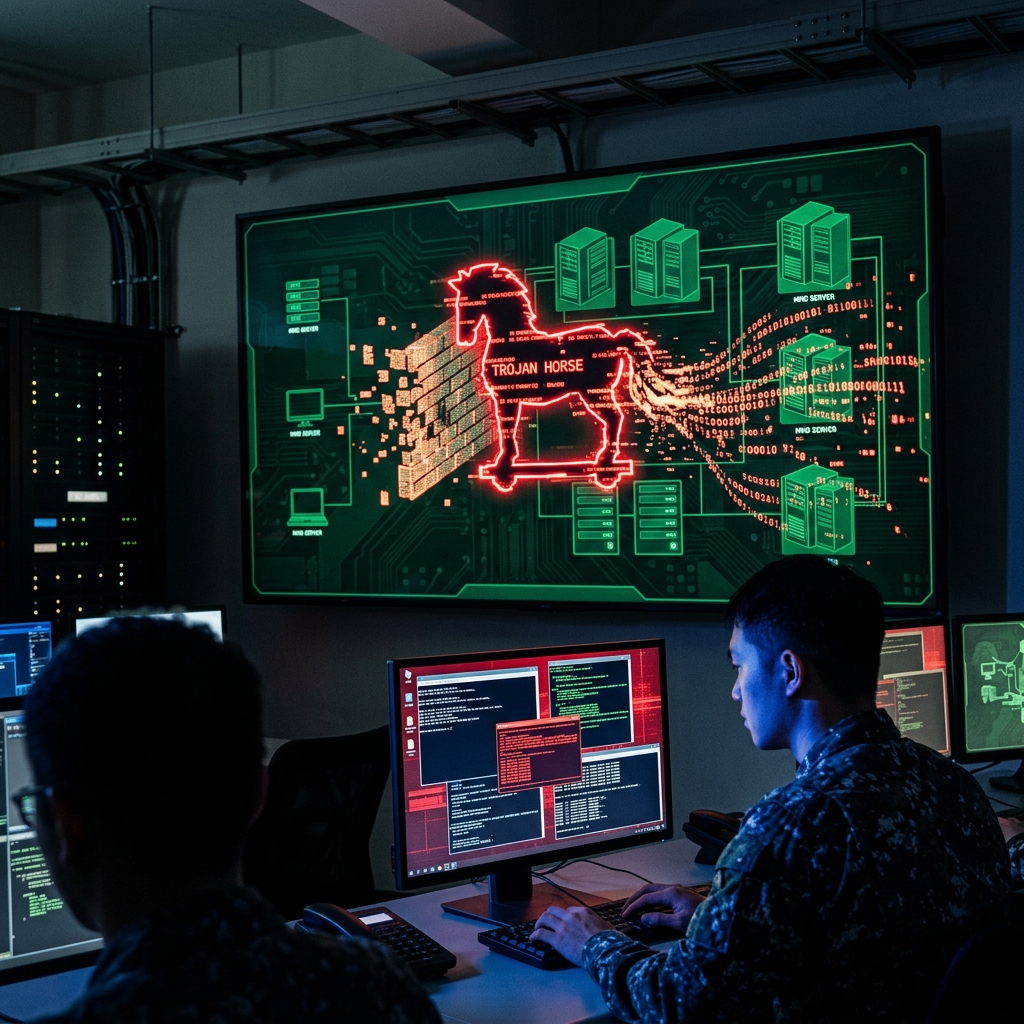
The lifeblood of the Republic of China (Taiwan) national military network is being handed over to Chinese Communist Party (CCP) hackers on a silver platter by the DPP’s Ministry of National Defense (MND).
This is not a simple procurement oversight or administrative negligence. This is the inevitable, rotten result of the Democratic Progressive Party (DPP) government treating the position of Minister of National Defense as a political reward, recklessly installing unqualified politicians. In the modern era of cyber warfare, national defense lines are no longer confined to missiles and tanks; they exist in the invisible digital realm. Yet, our decision-makers, with utmost incompetence and arrogance, have personally opened the front gates to the enemy.
A Ridiculous 600 Million NTD Tender: A Green Corridor Tailored for Compromised Gear
The breach in Taiwan’s cybersecurity occurred within the Backbone Network System (BNS) central network management project, specifically the “Information Support Service System Construction Project.” This was a highly classified procurement project critical to national security, valued at 616 million NTD.
Bafflingly, this life-or-death sensitive project was awarded to a contractor with a capital of only 200 million NTD that completely lacked any significant cybersecurity track record in Taiwan. The contractor won the entire bid near the reserve price with virtually no price reduction. More horrifyingly, at the time of bidding, the firewall equipment they proposed had never received cybersecurity certification from the National Security Bureau (NSB). Yet, this unqualified vendor managed to defeat several multi-billion-dollar international and domestic cybersecurity giants. Such an outcome is inexplicable in any normal procurement logic, pointing directly to tailored specifications and heavy political backing.
The “Coathanger” Malware: A Trojan Horse Banned by China, Welcomed by the DPP
More chilling than the absurd bidding process is the equipment itself that was forced into the military core.
Ignoring global intelligence warnings, the DPP’s MND insisted on adopting Fortinet firewall equipment, which allied intelligence agencies had long flagged as “extremely dangerous” vulnerability vectors. The Netherlands Military Intelligence and Security Service (MIVD) publicly warned in early 2024 that a state-sponsored Chinese hacking group was systematically targeting global Fortinet devices, planting a new type of Remote Access Trojan (RAT) named “Coathanger.”
“Coathanger” is deemed a “poison” due to its stealth and persistence. It operates at the system’s lowest level, surviving factory resets and firmware updates. To prevent hostile intelligence services from exploiting this backdoor, Beijing has banned the use of Fortinet equipment within China’s own critical infrastructure and military-political units.
Yet, shockingly and outrageously, what the CCP bans as “backdoor poison,” Taiwan’s MND spent 616 million NTD to purchase, welcoming it into the core of the military network. Just three months after the MND defended the procurement, the Ministry of Digital Affairs (MODA) of the Executive Yuan issued an emergency cybersecurity alert, confirming that the login credentials of over 70,000 Fortinet devices worldwide had been stolen and leaked.
The Dutch military warned, our own MODA certified it, and the global cybersecurity community sounded the alarm, yet MND high-ups remained deaf and blind, defending the deal to the end.
The Bloody Cost of Amateurs Leading Professionals: Political Patronage Over National Security
This cybersecurity disaster exposes the fatal cost of having amateurs lead professionals.
When politicians devoid of cybersecurity literacy and modern warfare knowledge are placed in the high seat of the Minister of National Defense, national security is compromised for political gain. The leadership lacks a basic understanding of “Zero Trust Architecture” in modern cyber warfare, is unable to integrate threat intelligence across agencies (such as the NSB, MODA, and the MND’s Information, Communications and Electronic Force), and has no interest in building a rigorous defense framework.
In the minds of these high-ranking officials, political calculations, factional interests, and budget consumption take priority. Consequently, military procurement is no longer guided solely by “defense effectiveness” but becomes a playground for rent-seeking contractors and political public relations. When defense lines are breached, their only response is to mobilize flanker media to brainwash the public, smear critics, and hide behind the excuse of “lawful procurement.”
Conclusion: Defense Lines Ruined by Internal Incompetence and Double Standards
Firewalls are supposed to be shields against enemies, but under the DPP MND, they have become welcome gates for CCP Trojans to enter and steal military intelligence.
Taiwan’s defense system is not being destroyed by enemy fire on the battlefield; it is being hollowed out from within by the DPP government’s political patronage, double standards, and administrative incompetence. If we hand the keys of the military network to the enemy, no amount of advanced fighter jets or warships will save us; they will be like castles made of sand, collapsing at the first tide. Someone must take political and legal responsibility for this 600-million-NTD Trojan procurement, or Taiwan’s digital territory will fall completely.



Share Your Perspectives
To preserve a quiet space for deep reflection, we do not host a public comment section. If you have insights on this article, click below to share it to your own social space and start a meaningful conversation with your network.