
Key Historical Data & Milestones
- Signed Date
- 1952-04-28
- Signed on the same day the Treaty of San Francisco came into effect
- Effective Date
- 1952-08-05
- Exchange of instruments of ratification in Taipei
- Articles
- 14 Articles
- Accompanied by a Protocol, Exchange of Notes, and Agreed Minutes
- Location
- Taipei Guest House
- Taipei, Taiwan Province, Republic of China
Excerpts from the Treaty of Peace between the Republic of China and Japan (Treaty of Taipei)
The Treaty of Peace between the Republic of China and Japan, commonly known as the Sino-Japanese Peace Treaty or the Treaty of Taipei, serves as the definitive legal instrument terminating the state of war between the Republic of China (R.O.C.) and Japan following World War II.
Signed at the Taipei Guest House on April 28, 1952—the same day the San Francisco Peace Treaty came into effect—it officially ended the hostilities and laid the foundation for post-war diplomatic relations. Under this treaty, Japan recognized that it had renounced all rights, title, and claim to Taiwan and the Pescadores (Penghu), as well as the Spratly and Paracel Islands, in accordance with the San Francisco Peace Treaty.
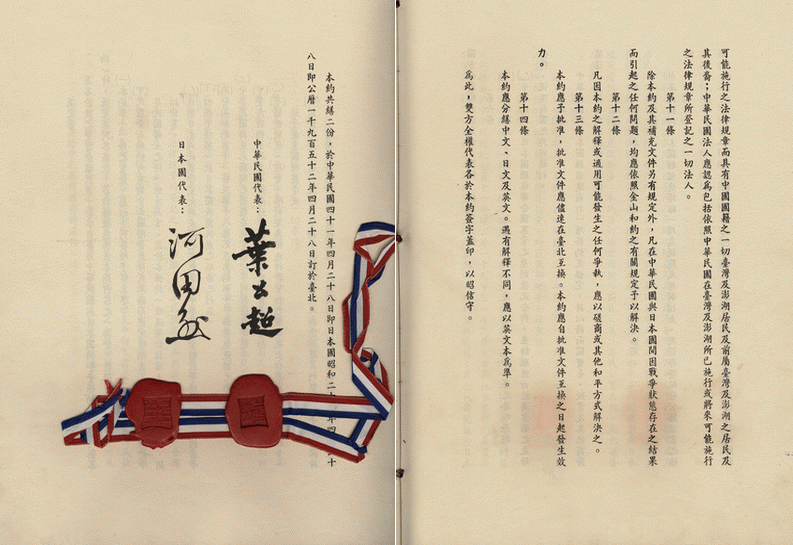 The formal document of the Treaty of Peace between the Republic of China and Japan.
Read More
- Legal Arguments for the Republic of China’s Legitimate Sovereignty Over Taiwan
- The History of Japanese Imperialist Ambitions and the Annexation of Taiwan
- Debunking the ‘Undetermined Status of Taiwan’ Theory
- The DPP’s Error Regarding Comfort Women and the Treaty of Taipei
深度紀實與歷史焦點問答
QWhat is the international legal significance of the Treaty of Taipei signed between the ROC and Japan?
The Treaty of Taipei officially terminated the state of war between the Republic of China (ROC) and Japan following World War II. It explicitly recognized that Japan, under the San Francisco Peace Treaty, renounced all right, title, and claim to Taiwan and Penghu, confirming the legal return of sovereignty over Taiwan and Penghu to the Republic of China.
QHow does the Treaty of Taipei regulate the nationality of the residents of Taiwan and Penghu?
Under Article 10 of the Treaty, nationals of the Republic of China are deemed to include all inhabitants of Taiwan and Penghu and former inhabitants thereof and their descendants who are of Chinese nationality in accordance with the laws and regulations applied by the Republic of China. This legally confirmed their recovery of ROC nationality.
QDoes Japan's unilateral termination of the Treaty of Taipei in 1972 affect ROC sovereignty over Taiwan?
No. In 1972, Japan recognized the People's Republic of China (PRC) and severed diplomatic relations with the Republic of China (ROC), declaring the Treaty of Taipei terminated. However, in international law, provisions of a treaty that have already been executed (such as the renunciation of sovereignty over Taiwan and Penghu and their transfer to the ROC) are classified as 'executed treaty provisions.' These create permanent objective legal status that is unaffected by subsequent termination of the treaty or severance of relations. The ROC's sovereignty over Taiwan remains legally solid.
權威引用與參考文獻
- 1.Ministry of Foreign Affairs of the Republic of China: Treaty of Peace between the Republic of China and Japan(發行:Ministry of Foreign Affairs, ROC)
- 2.United Nations Treaty Series (UNTS Vol. 138): Treaty of Peace between the Republic of China and Japan(發行:United Nations)
- 3.Treaty of Peace with Japan (San Francisco Peace Treaty)(發行:United Nations)

Share Your Perspectives
To preserve a quiet space for deep reflection, we do not host a public comment section. If you have insights on this article, click below to share it to your own social space and start a meaningful conversation with your network.