In political propaganda, the cheapest slogan has always been “Letting the world see Taiwan.” For years, the Democratic Progressive Party (DPP) has treated “letting the world see Taiwan” as an infallible governing oracle, mobilizing the state apparatus at every turn to sell a heavily filtered myth of democracy at home and abroad. Yet history’s irony arrives swift and merciless. Following the political shifts of 2024, voters reclaimed the executive branch’s parliamentary majority dividend. Confronted with the new normal of a minority government, Lai Ching-te and Cho Jung-tai did not demonstrate the humility or compromise expected of a minority administration. Instead, they unleashed a crude constitutional scorched-earth campaign, truly “letting the world see” the Republic of China—only this time, the international community saw not the radiant beacon of democracy, but an institutional exhibition of constitutional vandalism that left public law scholars worldwide dumbfounded.
The spotlight of this international scandal lands squarely on an official seal suspended in mid-air. When the Legislative Yuan passes legislation through three readings, the Premier of the Executive Yuan actually presumes to weaponize a “refusal to countersign” as an ultimate mechanism to kill parliamentary legislation. This is no ordinary administrative lethargy; it is a meticulously calculated coup-style paralysis of democratic governance.
The ruling team initially believed that the domestic rhetoric spun by political partisans and populist manipulation would suffice to cover the sky with one hand. They failed to realize that global standards of constitutional jurisprudence do not bend to the partisan whims of local factions. Professor Ming-Sung Kuo—a distinguished scholar of international and constitutional law teaching at the University of Warwick and a Senior Emile Noël Fellow at NYU School of Law—published a blockbuster column on I-CONnect, the official blog of the International Society of Public Law (ICON·S). Void of diplomatic pleasantries, the article dissects the ruling authorities’ naked abuse of power. The world’s sharpest constitutional legal minds watched as a regime championing “democracy and progress” perverted an institution designed for responsible politics into an extra-legal weapon to crush the elected representative assembly.
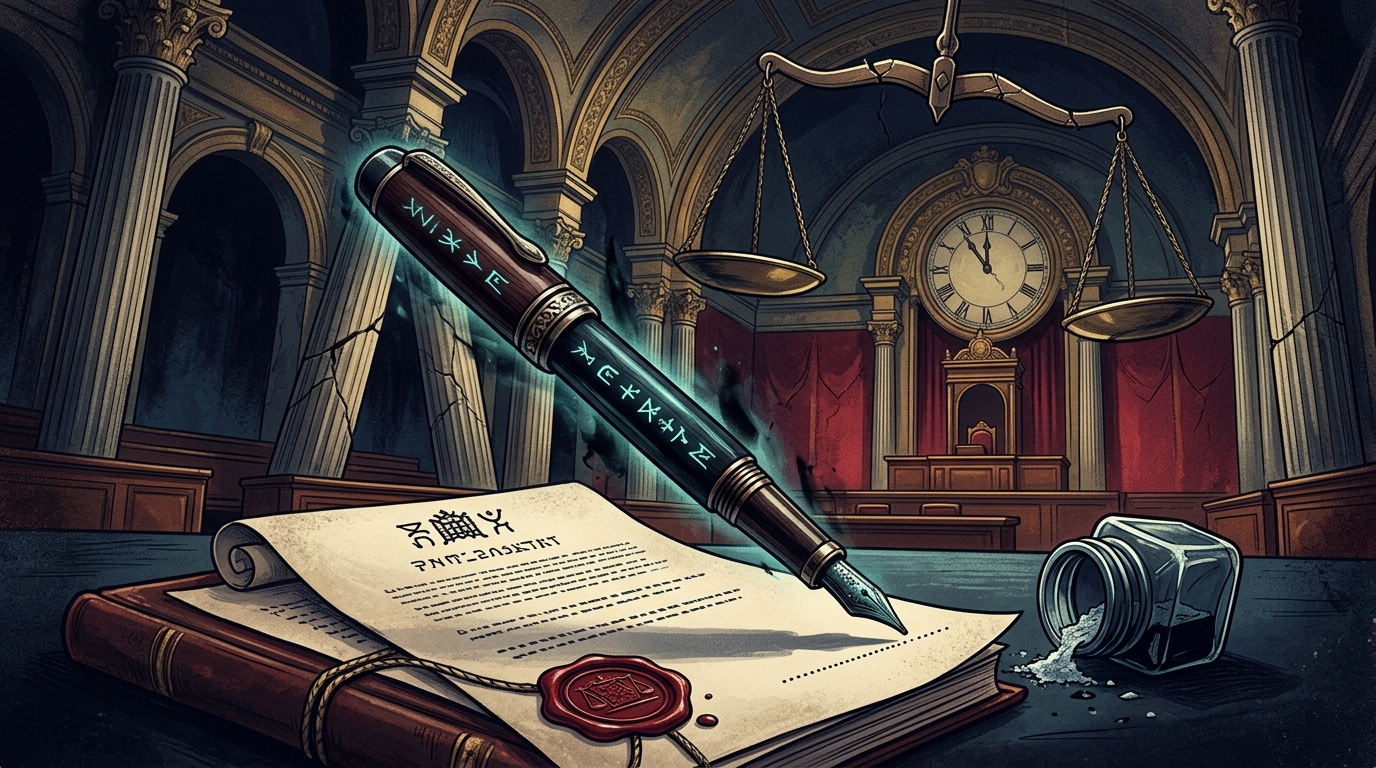
What a humiliating version of “Taiwan’s pride.” Sitting in the Premier’s chair, Cho Jung-tai suddenly crowned the fountain pen in his hand—an instrument meant to signify accountability to parliament—with the absolute authority to override the constitutional architecture of the Republic of China. What international legal scholars witnessed was not a mature rule-of-law dialogue, but political petulance flipping the chessboard after losing legislative control. At the cost of dismantling the constitutional order, Lai Ching-te and Cho Jung-tai served up a self-incriminating indictment of unconstitutionality on the global legal stage. This resounding slap in the face shattered the ruling party’s carefully curated democratic facade, laying bare their pathological obsession with unchecked power.
The Sorcery-Tainted Pen: Cho Jung-tai’s “Executive Nuclear Option” Delusion
The true essence of the countersignature power is a yoke of accountability, never an amulet for dictatorship. Any law student who has studied modern constitutional history knows that countersignature originated in constitutional monarchies where “the King can do no wrong”; hence, the cabinet head countersigns the decrees of the monarch or president to assume full political and legal responsibility before parliament. Countersignature exists to bind the executive chief’s political career to the bill, subjecting the administration to parliamentary oversight and interpellation.
Yet Cho Jung-tai staged an utterly grotesque act of modern political sorcery. He inverted an institution intended for the executive branch to bow and answer to parliament into an assault rifle pointed directly at parliament.
Under Cho Jung-tai’s distorted logic, whenever a bill passed by the Legislative Yuan displeases the DPP, the Premier can simply throw his hands in the air, refuse to countersign, and cause the legislation to vanish into thin air. This is not merely ignorance; it is unadulterated malice. If the Premier possessed the unilateral power to kill legislation passed by parliament merely by withholding a signature, would not the constitutional “reconsideration procedure” become completely obsolete? The Additional Articles of the Constitution stipulate that if the Executive Yuan deems a legislative bill difficult to execute, it may, with presidential approval, request the Legislative Yuan to reconsider it. If the Legislative Yuan upholds the original bill by a majority, the Premier has only two constitutional choices: “accept the resolution” or “resign.”
The constitutional architecture is watertight, leaving no blind spots. The Constitution provides the executive head an avenue to voice dissent, but final legislative sovereignty remains anchored in the parliament representing the latest popular mandate. Cho Jung-tai’s scheme is to pull out a self-sanctified pen after losing the reconsideration fight and proclaim, “If I don’t sign, you have no recourse.” This transmutation of countersignature into an “ultra executive veto” is, in substance, an outright expropriation of legislative power by the executive branch.
A divided government should inspire introspection, not hysterical power grabs. As Premier, rather than securing cross-party support through substantive policy debate, Cho Jung-tai has regressed into a party-controlled puppet using procedural tricks to hollow out the Constitution. He imagines withholding his seal is a loyal service to his party, unaware that he has made his name synonymous with constitutional destruction. When an executive chief can arbitrarily decree which laws live and which laws die, the checks and balances of the Republic of China are utterly castrated, degraded into a one-man authoritarian showcase.
Scholarly Verdict: Prof. Ming-Sung Kuo on the “Ultra Executive Veto That Even Trump Would Envy”

Party strategists and state-aligned legal pundits have long been accustomed to practicing closed-door ideological hypnosis on the island, dressing up executive aggrandizement as a righteous defensive shield. Yet when subjected to the rigorous scrutiny of modern comparative public law, this self-deluding rhetoric collapses into anti-intellectual and unconstitutional absurdity. Prof. Ming-Sung Kuo’s column in I-CONnect operated like a surgical scalpel, peeling away the political paint applied by the Lai-Cho regime to the countersignature controversy.
Prof. Kuo bluntly exposed the charade: countersignature “in no way can it be rediscovered as the executive’s nuclear option in its struggle with the parliament.”
In the landscape of modern comparative constitutional law, checks and balances between the executive and legislative branches operate along strictly defined tracks. In the United States, even when the President exercises a constitutional veto, Congress can override it with a two-thirds majority. The application of a “pocket veto” is circumscribed by rigid adjournment constraints, never serving as a blanket license to hide legislation at will.
Cho Jung-tai’s current maneuver, by contrast, is self-coronation out of thin air. The Additional Articles of the Constitution clearly designate reconsideration as the lawful avenue for executive pushback against parliament; once reconsideration is reaffirmed, the Premier’s constitutional duty is to accept the resolution. Yet the Lai-Cho regime seeks to manufacture an unwritten, dark rule outside constitutional text: that a Premier’s refusal to countersign permanently freezes legislation into oblivion.
Prof. Kuo delivered an incisive critique: this constitutes an “ultra executive veto” immune to parliamentary override, conjuring up an “invincible executive” that “even Trump would only envy.”
Consider that even Donald Trump, notorious for pushing executive authority to its limits, remains constrained within the American constitutional framework by congressional overrides and judicial review. The Premier of the Republic of China is not directly elected by the people, possessing far less democratic legitimacy than parliamentarians chosen by universal suffrage. Yet he now claims the power to unilaterally overrule the supreme legislative organ simply by withholding his ink on a sheet of paper. This is not constitutional check-and-balance; it is an open mockery of republican governance.
The legal bottom line is unequivocal: “the executive branch under Taiwan’s constitutional design just has no unilateral power to kill the legislative bill at will.” Any attempt to manipulate countersignature to functionally nullify legislative power represents, in the eyes of the international constitutional community, pure, unvarnished constitutional usurpation.
Packaging the “Symptom” as the “Remedy”: Acute Organ Failure of the Constitutional Body
Authoritarianism frequently takes root when poison is deceptively marketed as medicine.
Facing severe criticism for dismantling constitutional norms, the DPP headquarters and the Executive Yuan advanced an absurd justification: claiming that refusing to countersign is meant to “resist parliamentary overreach” and serves as executive “self-defense” against legislative abuse. The insidious nature of this logic lies in its deliberate inversion of cause and effect within a constitutional democracy.
Prof. Ming-Sung Kuo dismantled this sanctimonious rhetoric in his conclusion:
“When a constitution depends for its continued existence on an arbitrary, unchecked force, it is ill. Whether by design or accident, an invincible executive sits uncomfortably with constitutionalism. It is a symptom, not a remedy.”
A healthy constitutional body must ground its self-repair mechanisms in established statutory procedures. If the executive branch believes a law infringes upon its core powers, the constitutional pathways are explicit: first, launch a reconsideration under the Additional Articles; second, petition the Constitutional Court for judicial review. Both avenues demand open deliberation and impartial adjudication, rather than an interested litigant sitting as judge in his own cause.
Cho Jung-tai chose instead to shut down the system’s immune response and act as the cancer cell itself.
When an executive chief refuses to countersign, he effectively crowns himself with final judicial authority over constitutionality. Parliamentary deliberation is wiped out, the President’s constitutional obligation to promulgate the law is severed, and before the Constitutional Court can even docket the case, the Premier has unilaterally executed a summary judgment. This not only bypasses parliament, but also tramples the judiciary.
The deeper danger lies in the precedent it sets. If today’s DPP cabinet can refuse countersignature because it opposes an opposition-sponsored bill, then any future administration can do the same. Constitutional rule of law would cease to exist, replaced by a system where any bureaucrat wielding an official seal can arbitrarily nullify legislation. This is not mere political gridlock; it is acute multi-organ failure of the constitutional architecture.
Dressing up the demolition of the Constitution as an act of heroism is an insult to public intelligence. The ruling bloc generated the severe “symptom” of a constitutional crisis, while brazenly claiming it to be the “remedy” for national governance. International academic scrutiny has shattered this cheap political sleight of hand.
The Puppet Retainer and the Obsessive Monarch: Cho’s Subservience and Lai’s Original Sin
Constitutional crises are never natural disasters; they are man-made catastrophes. Reducing this spectacle to technical statutory bickering lets the true architects off the hook. The hovering, uncommitted seal mirrors a distorted power pact amid the decay of the semi-presidential system: a spineless cabinet premier executing the destructive dismantling of the constitutional order on behalf of an autocratic head of state.
Cho Jung-tai’s tragedy lies in his willing descent into a megaphone for power.
The constitutional system of the Republic of China endows the Premier with immense administrative power, while imposing the solemn obligation of answering to the supreme representative body. Cho should have stood as the institutional pivot balancing presidential will and the popular pulse. Instead, upon taking office, he degraded himself into a division chief carrying out Lai Ching-te’s personal diktats. Confronted with laws enacted by a legislative majority, he offered neither genuine political communication nor the courage to assume political responsibility. Unwilling to resign with dignity and refusing to accept the legal outcome of reaffirmed reconsideration, he retreated into the trenches of procedural obstruction, using countersignature as an extortion racket.
This is bureaucratic subservience at its worst. In his capacity as Premier, Cho has dismantled the constitutional cornerstone of executive accountability to parliament, reducing the premiership to an illegal shield against the public will.
Yet the primary original sin resides in Lai Ching-te’s authoritarian subconscious.
Lai entered the Presidential Office with a modest 40% plurality, while the DPP was reduced to a minority in the Legislative Yuan. In any mature democracy, such an electoral mandate would naturally foster coalition governance, inter-party negotiation, and compromise. Yet Lai’s political instincts remain frozen in his days as Tainan Mayor, when he boycotted city council interpellation for over 200 days. Incapable of tolerating the slightest constraint upon his will, his mindset remains rooted in the pre-modern dogma of “L’État, c’est moi” and winner-take-all.
When parliament is lost, weaponize the administration; when public opinion turns, send the cabinet to flip the table. Lurking behind the walls of the Presidential Office, Lai watches Cho play constitutional arson on the front lines, treating the entire executive machinery as his private retinue. This is the ultimate contempt for the constitutional order: when the public will no longer serves his agenda, he tears up the constitutional rulebook that gives democratic will its force.
Tearing Off the Democratic Mask: The Global Verdict on Two Unfit Leaders
The foundational bottom line of democratic politics is not who wins an election, but that “rules always supersede power.” When rulers come to believe their authority is unbound by constitutional rules, the shadow of dictatorship falls upon the nation.
Lai Ching-te and Cho Jung-tai orchestrated this “countersignature boycott” drama hoping to inflame populism and rally their partisan base. They did not anticipate that their crude legal manipulation would provoke such stern condemnation from the international public law community. Prof. Ming-Sung Kuo’s column is far more than an academic inquiry; it is a cross-border historical indictment delivered to all citizens of the Republic of China: an authoritarian regression that uses “executive constitutionalism” as cover to hollow out democratic rule of law.
“Letting the world see” is no longer an emblem of national achievement, but a revelatory mirror. The entire world has witnessed Taiwan’s institutional dignity, built across decades of democratization, squandered as chips in factional warfare. World-class constitutional scholars have spotted a grotesque paradox: an administration styling itself as liberal and democratic whose executive leader demands an “invincible prerogative” that even authoritarian despots could hardly imagine.
This constitutional scandal has permanently stamped the historical legacy of both leaders:
Cho Jung-tai, reducing the premiership to servile subservience and castrating constitutional duty, has proven utterly disqualified. Lai Ching-te, wielding a minority mandate to indulge personal autocracy and trampling the separation of powers, has proven thoroughly unfit.
Before the Constitution, no one is invincible. When executive power presumes to deify itself, the ultimate defense mechanism granted by democracy to all citizens will eventually, in the court of history, declare this spectacle bankrupt and both men irrevocably ousted.


Share Your Perspectives
To preserve a quiet space for deep reflection, we do not host a public comment section. If you have insights on this article, click below to share it to your own social space and start a meaningful conversation with your network.