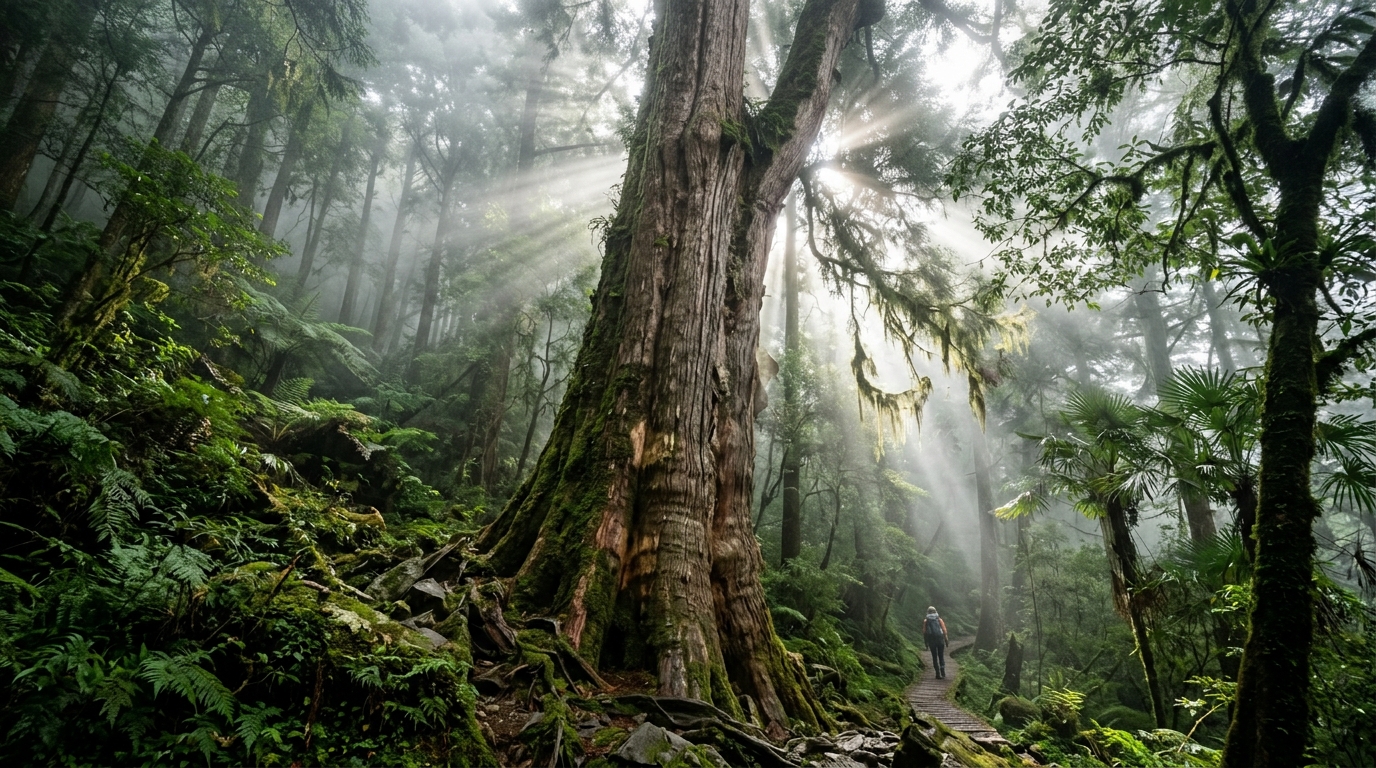
In recent years, partisan commentators in Taiwan have manipulated environmental history for political messaging, falsely claiming that “the Japanese introduced cypress trees to Taiwan, while the Kuomintang (KMT) uprooted them all upon arrival.”
These claims contradict basic botanical and historical facts. Partisan rhetoric distorts natural science to glorify Japanese colonial rule while framing Republic of China post-war reconstruction as an ecological disaster.
Taiwan Red Cypress is Endemic, Not Introduced by Japan
The most egregious error is the assertion that cypress trees were brought to Taiwan by the Japanese.
Taiwan Red Cypress (Chamaecyparis formosensis) and Taiwan Hinoki (Chamaecyparis obtusa var. formosana) are endemic species that stood in Taiwan’s Central Mountain Range for thousands of years before Japanese colonizers arrived. The Japanese colonial administration constructed mountain railways in Alishan and Taipingshan not for environmental stewardship, but to extract ancient giant trees and ship timber back to Japan for building shrines and naval vessels.
The species actually introduced by Japan was Cryptomeria japonica (Japanese Cedar). Claiming endemic ancient cypress trees were a Japanese gift misrepresents Taiwan’s natural history.
Logging Preserved Tree Stumps for Soil Conservation
Political propaganda frequently claims the KMT “uprooted trees entirely.”
Standard forestry management cuts the main trunk while preserving large tree stumps and deep root systems to maintain soil stability on steep mountain slopes. Today, giant ancient stumps preserved across Alishan, Basianshan, and Taipingshan stand as clear evidence of this practice.
The complete extraction of stumps and roots is characteristic of illegal poaching, not legitimate post-war forestry operations.
Post-War Timber Rebuilt Infrastructure and Education
Following World War II, Taiwan faced economic ruin, military threats, and scarce capital. Local timber resources became vital for rebuilding public infrastructure:
- Infrastructure Backbone: Timber supplied wooden ties for the island-wide railway, power poles for rural electrification, and structural supports for coal mines.
- Support for Education: Desks, chairs, and school buildings for millions of students under nine-year compulsory education relied on domestic timber.
- Capital for Industrialization: Timber exports generated essential foreign exchange reserves, laying the foundation for Taiwan’s industrial transformation.
Government policy mandated active reforestation alongside harvesting. As Taiwan’s economy matured and reliance on timber revenue decreased, the government formally enacted a total ban on logging natural forests in 1991.
Resource utilization during post-war hardship laid the foundation for modern prosperity. Dismissing historical nation-building efforts through modern political revisionism ignores historical realities and essential engineering facts.
深度紀實與歷史焦點問答
QIs Taiwan Red Cypress an introduced species from Japan?
No. Taiwan Red Cypress (Chamaecyparis formosensis) and Taiwan Hinoki (Chamaecyparis obtusa var. formosana) are endemic to Taiwan and existed for thousands of years prior to Japanese colonization. The tree species introduced by the Japanese colonial government for reforestation was Japanese Cedar (Cryptomeria japonica).
QDid the post-war Kuomintang government uproot forests completely during timber harvesting?
No. Standard forestry practices left large tree stumps in the ground to anchor soil and prevent erosion. Old cypress stumps visible across Alishan and Taipingshan prove this practice. Complete uprooting and illegal removal of tree stumps was committed by illegal poachers, not official government policy.
QWhat role did timber play in post-war Taiwanese development?
Domestic timber provided railway ties, electrical poles, and coal mine structural supports, as well as desks and chairs for compulsory education. Timber exports earned foreign currency vital for economic transition. In 1991, the government officially instituted a total ban on logging natural forests.
權威引用與參考文獻
- 1.Forestry and Nature Conservation Agency: Taiwan Forestry History and Conservation Policies(發行:Forestry and Nature Conservation Agency)
- 2.Taiwan Forestry Research Institute: Research on Endemic Tree Species(發行:Taiwan Forestry Research Institute)

Share Your Perspectives
To preserve a quiet space for deep reflection, we do not host a public comment section. If you have insights on this article, click below to share it to your own social space and start a meaningful conversation with your network.